Assassin's Creed publisher Ubisoft wants all employees to work in-office five days per week, but unions in Milan and Montreal have mobilised in defiance.
"This is your crisis, this is your failure:" Inside the global battle to preserve remote working at Ubisoft
Assassin's Creed publisher Ubisoft wants all employees to work in-office five days per week, but unions in Milan and Montreal have mobilised in defiance.
Ubisoft employees have some choice words to describe how the publisher's five-day return to office mandate is being justified and received internally. Unionised workers in Milan described the directive as "madness." Their peers in Montreal said company leadership has proffered some of the "most condescending corporate-speak and faux-sympathy" in response to rising discontent.
There's more where that came from, but first, some context. Earlier this year, Ubisoft restructured around five 'Creative houses' to "regain agility and drive a sharp rebound, renewing the Group’s trajectory toward sustainable growth." In addition, the French company said it would be requiring all teams to work on-site five days per week.
Layoffs and numerous studio closures followed (including more this week)—and now, with the demise of remote working looming large, Ubisoft union workers in Milan have staged a six-day strike in protest. Across the pond, their Canadian colleagues—coming together as Ubisoft Workers of Montreal (UWM) with support from GWU Montréal—have launched a petition to preserve hybrid work at Ubisoft Montréal before "deteriorating conditions become the status-quo." The company's RTO mandate is already being enforced at the Montreal studio, where it was implemented on October 1, 2026.
A cohort of UWM workers, speaking to Vertical Slice as an anonymous collective over email, explained that over 750 people have already signed the petition. They also outlined their belief that a hybrid work model is fundamental to a healthy work-life balance and inclusion within the workplace.
"Full-time work in the office disproportionately affects marginalized people, as well as parents caring for their young children, colleagues who act as caregivers for members of their family, and people who have to live father away from the office due to rising costs of living. This one-size-fits-all approach doesn’t account for individual needs that can change swiftly," said UWM members.
"For many of our colleagues, the option to work remotely a couple of times per week really does mean the difference between being able to stay in their current job or not."
UWM workers feel that individual teams and managers within Ubisoft should collaboratively decide what's best for them. Hybrid working, they say, would accommodate a wide spectrum of needs, including those who feel they're more productive in an office environment. We're told that flexibility should be viewed as a provision that benefits everyone—employers included.
"Life is hard for a lot of people right now. For many of our colleagues, the option to work remotely a couple of times per week really does mean the difference between being able to stay in their current job or not," they continued.
"As a disabled person, I saw a vast improvement on my work-life balance in a hybrid model where I could work with my manager to decide what times were best for in-office presence while allowing for deep focus periods in the environment that suited me best on that day. Sometimes that meant I focused better at home; sometimes better in the office."
It's a view shared by Ubisoft Milan employees striking under the Ubisoft Workers' Council (RSU) banner as members of the FIOM-CGIL union. Speaking to Vertical Slice anonymously over email, the group said they are not seeking a blanket work-from-home policy, but rather a system that more effectively accommodates the needs and preferences of individuals.
"We think that if a job is doable remotely, people should have the right to choose to do it remotely. A lot of our job is done remotely regardless when collaborating with other teams, and the pandemic showed us it's possible to build a team remotely and have good communication across teams," they explain.
"We do know there's people who prefer working in the office, and that some activities or job classes can require occasional or frequent office presence, but we don't think that presence should be completely forced and required. The answer is flexibility when possible."
On the subject of flexibility, a Ubisoft representative provided the following statement:
"The [in-office] model includes annual remote working day allocations and accommodations for individual circumstances, providing employees with continued flexibility while supporting greater in-person collaboration. We believe spending time together helps strengthen teamwork, knowledge sharing, mentoring, learning and the day-to-day interactions that contribute to creativity and long-term team development."
If you can make hit video games at home, why mandate a five-day RTO?
We ask employees at Ubisoft Montreal and Milan why they feel Ubisoft is adopting such a sweeping return-to-office policy—and, crucially, how the publisher is rationalising that decision internally? UWM workers say that attempting to glean the company's honest reasoning is akin to reading tea leaves. "No one believes they've gotten a straight answer," we're told.
There are, mind you, some popular theories.
"This is a mass layoff in disguise. Management wants to force people who have built their lives around the option of hybrid work to just quit," they suggest. "[Or perhaps] Yves Guillemot is grasping at straws to save the company and thinks this will turn things around. RTO is the classic tech industry response to falling profits because it distracts from the root causes, like poor strategic decisions or wasteful spending, and instead puts the blame on workers, as though hybrid work somehow makes us less productive."
Those in Montreal claim Ubisoft has issued "vague statements" indicating that juniors aren't receiving proper mentorship because too many seniors are currently remote. That, they say, is the closest they've had to "concrete justification." There's a broad sense that this is simply happening whether Ubisoft employees like it or not. Internal managers have purportedly adopted a familiar refrain when toeing the company line: "focus on what you can control."
RSU Ubisoft members claim the messaging sent their way has been similarly opaque. "[Ubisoft management] say it's about office life and spontaneous interaction, but there's thousands of studies proving that people are more productive when working in a flexible arrangement. We also know that, anecdotally—we produced and shipped a great game during the pandemic," they explain.
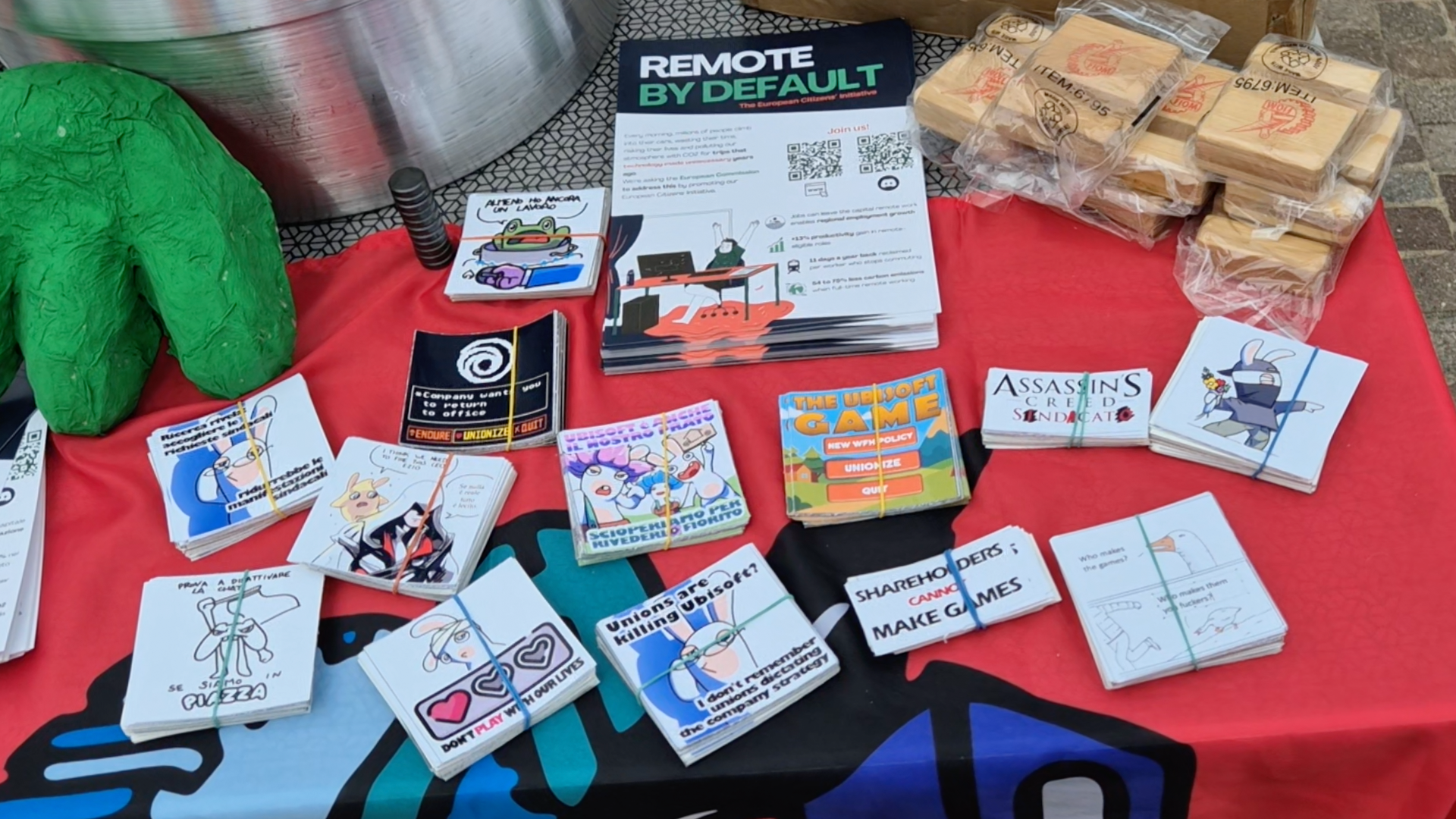
RSU Ubisoft union materials carrying messages like 'Remote By Default' and 'Shareholders Cannot Make Games'
For its part, Ubisoft said it understands the shift towards an in-office model "represents an adjustment for some employees" and said it will "continue supporting our teams throughout the process."
"We remain committed to conducting discussions through the appropriate local processes and in a spirit of constructive dialogue with employee representatives. As these discussions are ongoing, we will not comment further on local consultations or employee participation in specific actions," continued a company representative. "[...] We respect the right of employees and employee representatives to express their views."
Ubisoft said the model is being implemented "progressively" and remains subject to applicable local legal requirements and, wherever relevant, employee representative consultations.
Yet, according to those we spoke with in Milan, losing remote working provisions has "wrecked" morale, leaving those at the studio feeling more devalued and alienated than ever. "We are all on edge and worried about losing colleagues, money, [and our] work/life balance," they add.
Morale has also taken a hit in Montreal, where UWM workers claim Ubisoft has abandoned some of the amenities that made office work palatable as a result of the COVID-19 pandemic. The ever-increasing cost of living is also weighing on the minds of employees at the Canadian studio.
"There’s no more cafeteria in the office that provides meals at a lower cost, most people haven’t received raises that keep up with inflation, and now we are having extra expenses incurred by commuting to the office," they claim. "For the people who live farther away and must drive to the office, there isn’t enough parking in the area to accommodate them. RTO was implemented without giving us anything to offset the cost."
"Our goal is for workers in Montreal to realize they can have a voice"
Is there an upside to any of this? Well, for those at Ubisoft involved in the anti-RTO revolution, solidarity has become a tangible silver lining. UWM members explain they're in contact with other Ubisoft unions around the world and have been "deeply inspired" by the fights they have taken on. They're optimistic that Ubisoft employees will continue banding together to answer management "collectively" whenever life-altering decisions are rolled out.
"Our goal is for workers in Montreal to realize they can have a voice when our employer unilaterally makes decisions that impact our life, and that we are stronger when we act collectively. This petition campaign is the first step in that direction," they explain.
"Within the first week of the petition drive, 750 Ubisoft Montreal workers had already signed on to our demand to preserve hybrid work and we’re organizing to get hundreds more signatures. If management fails to acknowledge the petition, we’re going to invite everyone who signed to come together and democratically decide what happens next. [...] What could be more collaborative than hundreds of workers coming together to defend a hybrid work policy that so many of us depended upon for our quality of life?."
Ubisoft Montreal workers are petitioning their employer to preserve hybrid work
Back in Italy, RSU Ubisoft members say they're in constant contact with other unions fighting for their future. "[We're] helping each other wherever we can," they say. When asked what message RSU Ubisoft would like to collectively send their employer as their strike reaches its conclusion, the group stands resolute.
"These past two weeks, many of us have participated in the six-day strike when we were supposed to be shipping Rayman, and it is because of you. You have not fully grasped how self-destructive this Return to Office policy is. You have refused to even let us negotiate about these policies. And maybe it's because you forgot that games aren't done on their own. We are striking and we will continue to take action because we know this simple truth: people make games, because we care about our job and we care about the long-term future of this company," they say.
"You have failed, and now you want the price to be paid by your employees. This is your crisis, this is your failure, and we are not going to pay for it. It's time to start rebuilding trust in your employees and by your employees. Cease this madness now. Ubisoft can make great games only if the well being of the people making them is taken into account. What we ask is to listen to what we need to be able to keep the partnership going."
Chris is an award-winning reporter with over a decade of experience covering the video game industry. He was formerly news editor at Game Developer and is currently the founder and editor of this resplendent website.